What Is Midlife Identity and Why It Shapes Everything About Your Life


Your midlife identity isn’t just about knowing who you are; it’s the quiet foundation beneath every thought you think, every choice you make, and every version of life you believe you’re allowed to have.
If you’ve been feeling lost, restless, or disconnected from yourself somewhere in your forties or fifties, you’re not imagining it, and there’s nothing wrong with you.
I created Becoming Her: A 30-Day Identity Shift Journal for Midlife Women who are ready to stop wondering who they are in midlife and start genuinely finding out, and if that’s you right now, it might be exactly what you need.
What you’re experiencing is an identity shift, and understanding what midlife self-identity actually means is the starting point for everything else.
This is the foundational post for all the identity work we explore on this blog, so let’s start at the very beginning.
What Does “Identity” Actually Mean?
Most of us think of identity as a fixed thing – a set of personality traits, a job title, a role in the family – but identity is actually far more fluid and far more powerful than that.
Your identity is the collection of beliefs you hold about who you are and what you’re capable of.
It’s the story you tell yourself about your own life, often without realizing you’re telling it, and it’s the lens through which you see everything.
That inner story quietly determines:
- How you show up in your relationships
- How much you believe you deserve
- How open you are to change
- Whether you trust yourself enough to build a different kind of life
Your identity isn’t who you fundamentally are at your core; it’s who you’ve been taught to believe you are, and those are two very different things.
How Identity Is Built (and Why It Feels So Real)
Self-Identity doesn’t arrive fully formed; it builds slowly over the years, shaped by everything you’ve experienced and been told.
It starts in childhood, where the messages you absorbed from family, culture, and the world around you begin forming the first layers of your self-story. Over time, those messages became thoughts, those thoughts became beliefs, and those beliefs became the invisible architecture of your identity.
The cycle works like this:
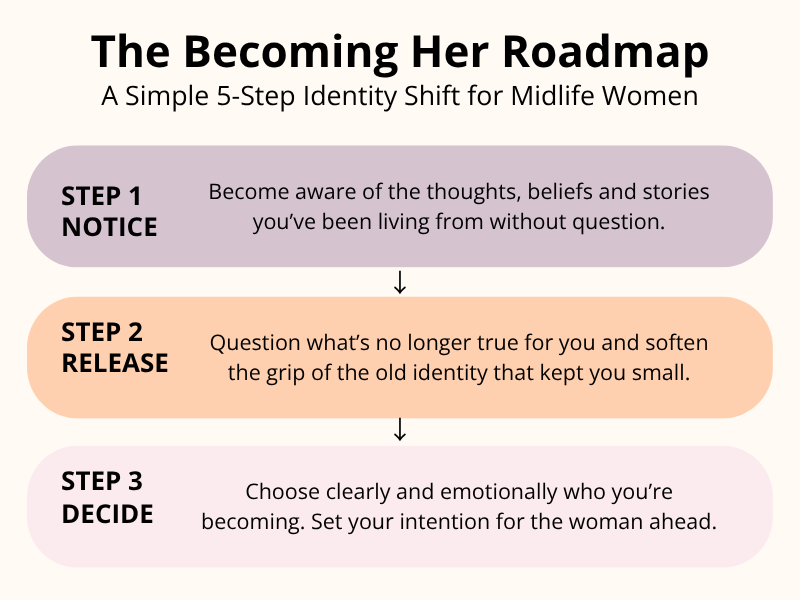
🌸 Not Sure Where To Start?
The Becoming Her Roadmap is a free 5-step framework for midlife identity shift.
Show Me The Roadmap- A thought, repeated often enough, becomes a belief
- That belief creates an emotional response
- That emotion influences the actions you take, or don’t take
- Those actions reinforce your sense of who you are
Round and round it goes, quietly beneath the surface, building a version of you that may or may not reflect who you actually want to be.
This is why it matters so much, because we carry beliefs we picked up decades ago as if they’re still the current truth.
“I’m not the kind of person who…” or “women like me don’t…” or “it’s too late for me to…”
These aren’t facts; they’re old stories that have been repeated so many times they feel like facts.
I’ve seen this happen with so many women, and I’ve felt it myself. The story gets so familiar that you stop questioning whether it’s even true.
What Happens to Self-Identity in Midlife
For most women, midlife brings an identity disruption that can feel deeply unsettling, even when it’s actually a profound and necessary awakening.
For the years leading up to midlife, your identity was likely built around your roles: mother, wife, daughter, caregiver, employee, helper. Those roles were real, and they mattered deeply, but they were built around what you did for and gave to others, and over time, many women quietly lose track of who they are underneath all of that.
Then something shifts. It might be:
- The children leaving home
- A relationship ending
- A career chapter closing
- Or simply waking up one day with a strange emptiness where your sense of purpose used to be
Suddenly, the roles that once told you who you were don’t hold the same weight, and you’re left asking a question you may not have asked since you were very young: Who am I now?
If you’re ready to go deeper on your journey, the Becoming Her: A 30-Day Midlife Identity Shift Journal was created to help you get quiet, get honest, and reconnect with the woman you’re becoming – one guided prompt at a time.
That question can feel frightening, but it’s actually one of the most important questions you’ll ever sit with, because it’s the doorway to the most authentic version of yourself you’ve ever inhabited.
Midlife isn’t an identity crisis; it’s an identity clarification. The noise of performance and proving starts to fade, and what’s left is a deeper, quieter truth about who you actually are and what genuinely matters to you.
If you’re in the middle of this right now, you might want to read more about how to rediscover your identity in midlife and the specific signs that you’ve been living for everyone else.
Why Your Midlife Identity Affects Your Goals
Here’s where identity gets really important, and it’s the piece most people miss entirely.
You can set as many goals as you like, but if your inner identity doesn’t match what you’re reaching for, your subconscious will quietly work against you every single time.
This isn’t a mindset problem; it’s an identity alignment problem.
Some examples that might feel familiar:
- You want more confidence, but your identity still carries the story “I’ve always been a worrier,” so confidence feels like a performance rather than a natural way of being
- You want to reinvent your life, but your identity holds the belief “women like me don’t get to start over,” so you find yourself self-sabotaging in ways you can’t fully explain
- You want to take up more space, but a lifetime of shrinking means your nervous system treats visibility as a threat
This is why goals without identity work so often stall.
The goal lives in the future; the identity lives right now, in every cell of your body and every thought that passes through your mind, and until the identity catches up, the goal stays just out of reach.
The shift that actually changes things isn’t trying harder; it’s asking a different question.
Not “what do I want to have?” but “who do I want to become?”
That’s the difference between setting a goal and setting an intention, and it’s a distinction that becomes especially powerful in the second half of life. You can explore that idea further in the difference between a goal and an intention.
Why Your Self-Identity Affects Your Ability to Change
You’ve probably experienced this already. You’ve made a decision, maybe dozens of decisions, to do things differently – to take up more space, to stop putting yourself last, to finally build the life you actually want – and yet somehow, a few weeks later, you’re back where you started.
This isn’t a willpower failure; it’s because change that’s not rooted in an identity shift tends not to hold.
Your subconscious mind is always working to bring your outer experience into alignment with your inner story, and when the inner story doesn’t change, the outer life keeps snapping back.
Real, lasting change starts from the inside.
It starts with:
- Shifting what you believe about yourself
- Gently questioning the old stories that built the current version of your identity
- Consciously choosing a new narrative, not forcing it or faking it, but genuinely inviting a different story to take root
Related Reading: Is a Midlife Identity Shift Right For You?
This is the whole philosophy behind identity journaling, and it’s why reflective practice matters so much more in midlife than simply setting better intentions or making stronger resolutions.
Why Your Midlife Identity Is the Root of Everything Else
Your midlife identity shapes how you experience all of the big themes that women come to this blog to explore.
It shapes your confidence, because the level of confidence you believe you’re capable of is always a reflection of what your identity tells you you deserve.
It shapes your relationships, because how much you ask for, accept, and offer is filtered through your sense of self-worth.
It shapes your sense of purpose, because you’ll only pursue the things that feel congruent with who you believe you are.
It shapes your capacity for joy, because allowing yourself to feel genuinely happy, expansive, and free requires believing, at an identity level, that you’re allowed to.
There are specific layers worth exploring when you’re ready, including how your limiting beliefs block what you most want, how negative self-talk in midlife keeps the old identity in place, and how the restlessness of midlife identity loss is actually a signal that something truer is trying to emerge.
The Beautiful Truth About Midlife Self-Identity
Your identity is not fixed, and that’s probably the most important thing I want you to take away from this post.
It was built from repeated thoughts, absorbed stories, and experiences that felt defining at the time, and because it was built, it can be rebuilt – not by force, not by pretending to be someone you’re not, but by gently and consistently choosing a different story, one thought at a time.
Midlife, for all its discomfort, is the most powerful moment in your life to do this work, because you’ve lived enough life to know what doesn’t fit anymore, you’ve learned to sense when something’s out of alignment, and you’re no longer willing to keep shrinking yourself to fit a story that was never really yours to begin with.
You don’t need to tear your life apart to discover who you really are; you just need to get quiet, get honest, and start asking better questions.
If you’re ready to do that with some real structure and support, the Becoming Her: 30-Day Identity Shift Journal was created for exactly this moment, taking you through 30 days of gentle, guided identity work, one honest question at a time.
🌸 Ready to go deeper?
The Becoming Her Journal was made for exactly this moment. Thirty days of guided prompts, reflections, and identity work written just for you.
Show Me The Journal