What Nobody Tells You About Identity After Retirement (And Why It Matters)

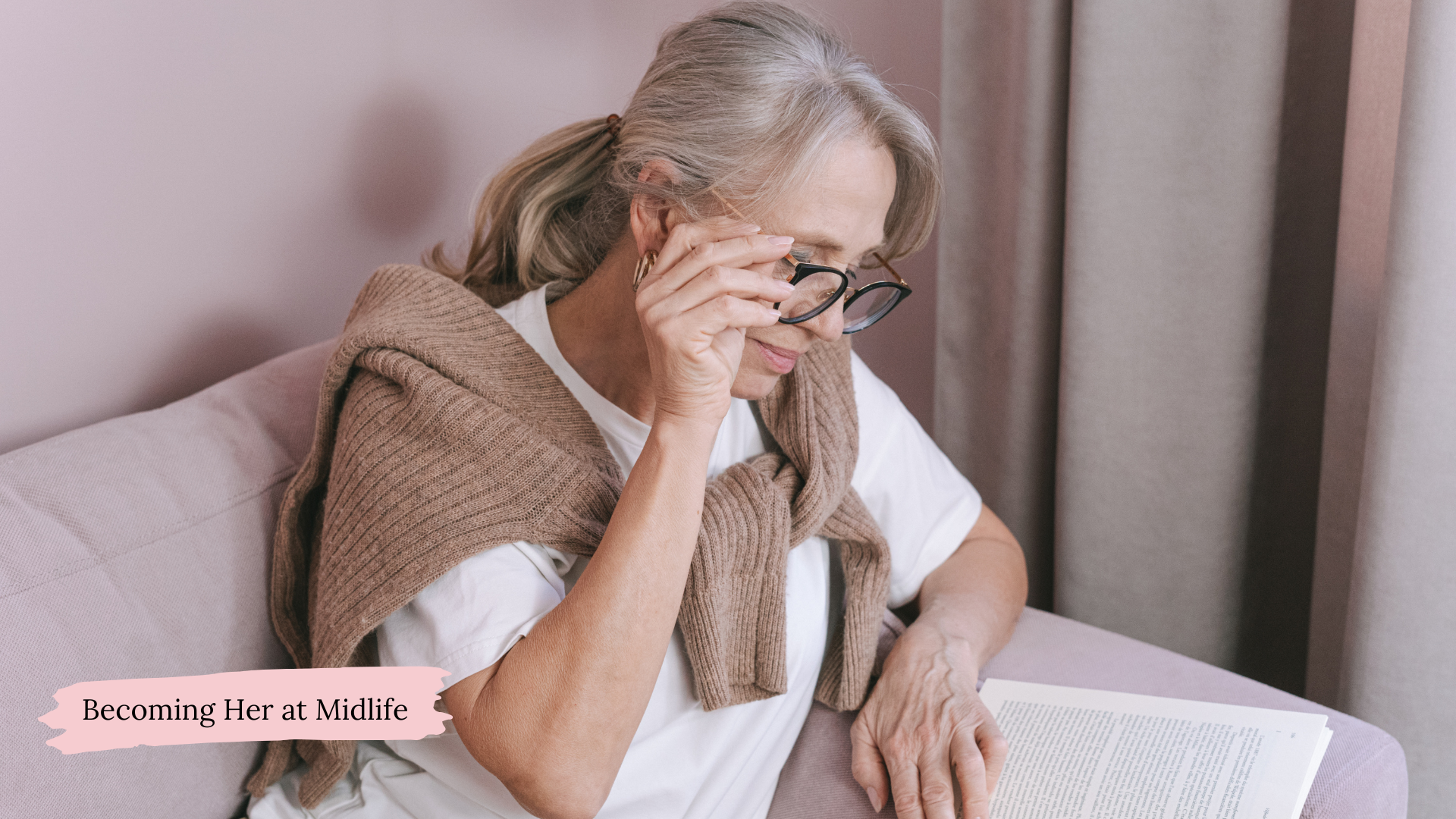
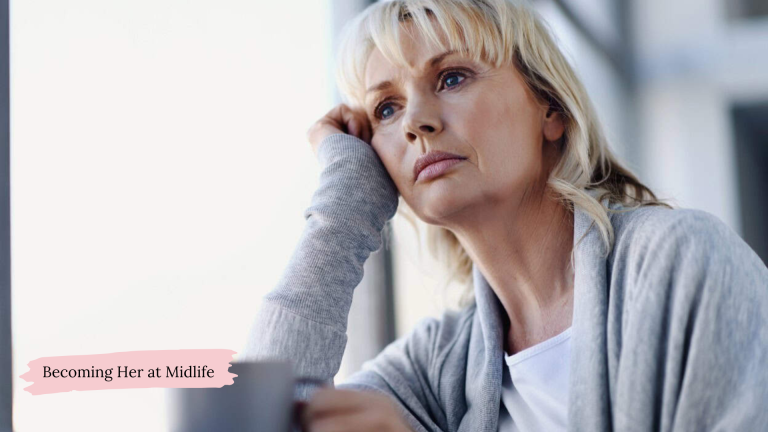
Nobody warns you that the hardest part of retirement might not be the change in your schedule, but the change in how you see yourself.
You’ve spent decades building a version of you that was deeply tied to what you did, and then one day that role is simply gone.
Something brought you to this page today, and I don’t think that’s an accident – if you’re feeling the pull toward something more, my Becoming Her: A 30-Day Identity Shift Journal for Midlife Women is a gentle, guided way to start exploring who you really are in this next chapter of your life.
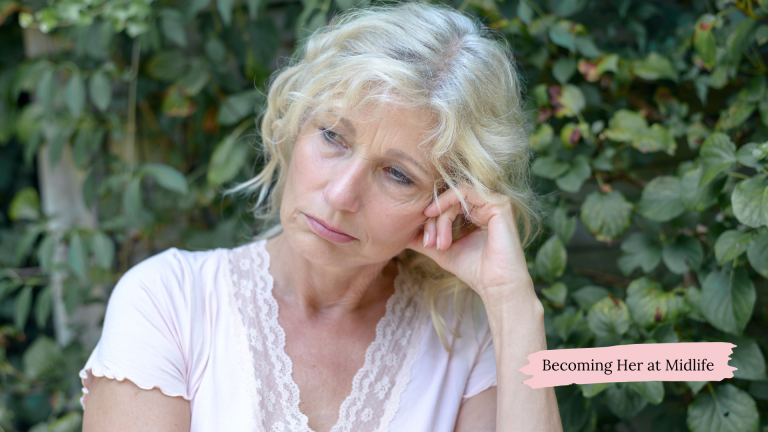
If you’re navigating identity after retirement and feeling more lost than liberated, you’re not alone, and you’re not overreacting. This disorientation is one of the most common and least talked-about experiences women face in this stage of life.
Why Retirement Can Shake Your Sense of Self
For most of us, our work identity runs deeper than we ever realized. It’s not just a job title, it’s the answer to “Who are you?” that you’ve been giving at every dinner party for the last thirty years.
When that answer disappears, the question suddenly feels a lot harder to answer.
Here’s what tends to catch women off guard when they first retire:
- The freedom they expected feels more like emptiness
- The structure they took for granted is suddenly gone
- The casual daily social connection vanishes almost overnight
- The sense of being needed, recognized, and valued quietly fades
- The question “So what do you do?” starts to feel uncomfortable rather than easy
I remember reading something once about how identity isn’t really about what you do; it’s about the story you’ve built around yourself over time.
Retirement doesn’t just change your schedule; it can feel like it rewrites a chapter you thought was already finished.
The Identity Gap Nobody Prepares You For
There’s a phrase I find really useful here: the identity gap.
It’s that stretch of time between who you used to be and who you’re in the process of becoming. And it can feel genuinely disorienting, even when nothing has gone wrong.
You might find yourself feeling:
- Purposeless, even though you have more freedom than ever
- Invisible, as if you’ve stepped off a stage and no one noticed
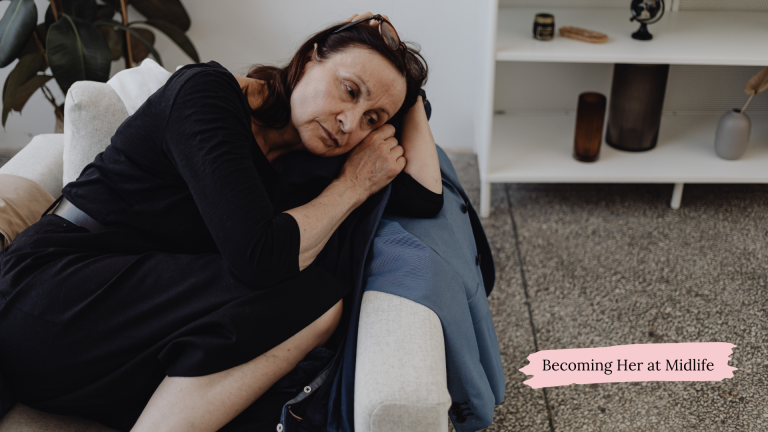
- Restless and unsettled in a way that’s hard to explain to people who haven’t been there
- Like you’ve lost your footing on something that used to feel solid
This isn’t a sign that you made the wrong choice or that something is wrong with you. It’s a completely understandable response to losing an identity that’s been central to your life for decades.
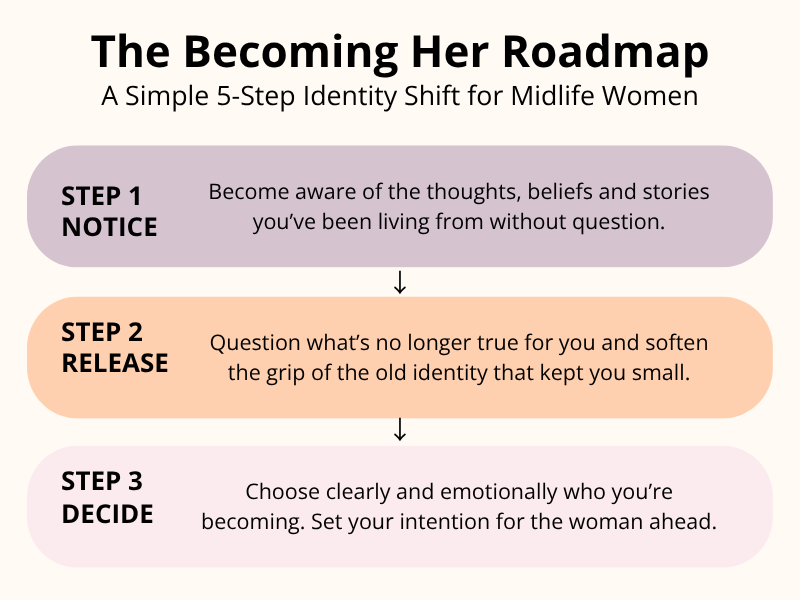
🌸 Not Sure Where To Start?
The Becoming Her Roadmap is a free 5-step framework for midlife identity shift.
Show Me The RoadmapYour Identity Was Never Just Your Job Title
Here’s the thing that takes a while to really absorb: your career gave you a container, but it was never the whole of you.
The qualities that made you good at your work – your curiosity, your care, your creativity, your way of thinking through problems – those don’t retire with you.
They’re still there, waiting to find a new container.
This is actually one of the most powerful reframes available to women at this stage.
Instead of asking “Who am I now that I’m not working?”, you can start asking “Who do I get to be, now that I have the space to choose?”
That’s a different question, and it opens up a very different kind of answer.
How to Rebuild Your Sense of Identity After Retirement
This isn’t something that happens in a weekend, and so you don’t need to have it all figured out immediately. But there are real, grounded things you can do to start reconnecting with yourself:
➤ Name what you’re actually feeling. Restlessness, purposelessness, and low-level sadness are all normal.
Naming them honestly is the first step toward working through them rather than around them.
➤ Get curious about what you actually value, separate from what you used to do. Ask yourself what lit you up inside your work and what drained you.
Often, the things that energize you are pointing toward something important.
➤ Start exploring, not deciding. You don’t need to find your new identity right now.
You just need to start paying attention to what feels alive and what feels flat.
➤ Resist the urge to fill every hour immediately. The discomfort of unstructured time is part of the process.
Sitting with it, rather than rushing past it, is where a lot of the real self-discovery happens.
➤ Write it down. Journaling your way through this transition is one of the most effective tools available, because it slows your thinking down enough to hear what’s actually going on underneath the noise.
You’re Not Starting From Scratch; You’re Starting From Experience
One of the most unhelpful ideas that can creep in during this transition is the feeling that you’re somehow starting over with nothing.
That’s not what’s happening here.
You’re bringing decades of lived experience, hard-won self-knowledge, and a much clearer sense of what you don’t want.
That’s not nothing; that’s actually a remarkable starting point.
Identity after retirement for women isn’t about reinventing yourself from zero. It’s about letting go of a version of yourself that served a particular season of your life, and making space for the woman who’s been waiting quietly underneath it all.
I’m still figuring out parts of this myself, but what I know for sure is that the women who come through this transition with the most clarity are the ones who do the inner work rather than skipping over it.
What Comes Next Is Up to You
The version of you that exists on the other side of this transition can be more intentional, more aligned, and more genuinely yours than any identity you’ve worn before.
That’s not wishful thinking; it’s what happens when you stop building yourself around what you do and start building yourself around who you actually are.
If you’re in the middle of this right now and you’re looking for a structured way to work through it, the Becoming Her 30-Day Identity Shift Journal was created for exactly this moment.
It’ll walk you through the process of releasing your old identity, reconnecting with what you truly value, and stepping into a version of yourself that feels real and chosen.
🌸 Ready to go deeper?
The Becoming Her Journal was made for exactly this moment. Thirty days of guided prompts, reflections, and identity work written just for you.
Show Me The Journal