
The Story You Keep Telling Yourself That Isn’t True – Here’s How To Finally Stop Believing It


There’s a voice inside your head that’s been running the show for decades, and there’s a good chance it’s been lying to you.
Negative self-talk in midlife isn’t dramatic or loud, and it certainly doesn’t announce itself.
If something brought you here today, it might be worth exploring further with Becoming Her: A 30-Day Identity Shift Journal for Midlife Women. This is a 30-day guided journal designed specifically for women navigating the beautiful, complicated work of midlife reinvention.
It whispers so consistently that you’ve stopped noticing it’s even there, and somewhere along the way, you started taking it as fact.
If you’ve been feeling stuck, small, or like something is fundamentally wrong with you, it’s worth asking whether you’re living out of truth or out of a story that stopped being true a very long time ago.
Where the Story Came From
Most of the narratives we carry weren’t chosen.
They were absorbed, picked up quietly from childhood, from the way people spoke to us, from the relationships that shaped us, from a culture that had very specific ideas about what a woman should be and how much space she was allowed to take up.
You heard things, and you internalized them. And over the years of repetition, those things became beliefs, and those beliefs became the lens through which you’ve seen yourself ever since.
I’ve seen this pattern so many times, and I remember the moment I first realized how much of what I believed about myself had nothing to do with me at all.
It was actually quite startling, but then it was the most freeing thing in the world as I set out to change those false beliefs.
The Stories That Show Up Most in Midlife
They tend to sound something like this:
- “It’s too late for me to start over.”
- “I’ve never been good at following through.”
- “Other people get to have that kind of life, not me.”
- “I’m not the kind of woman who does bold things.”
- “I don’t have what it takes.”
These thoughts might have once felt like protection because keeping expectations low felt safer than being disappointed. But they’ve quietly become the walls of your identity, and now they’re keeping you from the very things you’re craving.
Why You Believe Them So Deeply
Here’s the thing about a thought you’ve repeated for years: it doesn’t feel like a thought anymore.
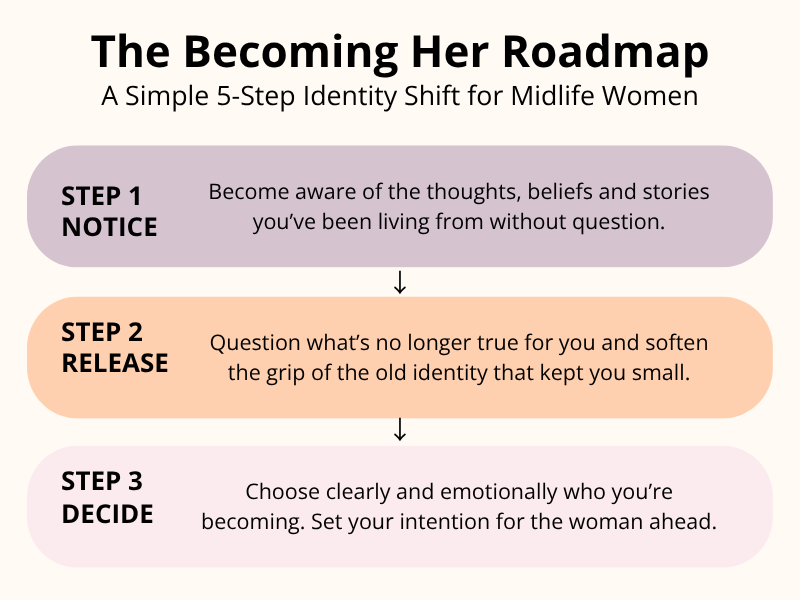
🌸 Not Sure Where To Start?
The Becoming Her Roadmap is a free 5-step framework for midlife identity shift.
Show Me The RoadmapIt feels like a truth.
Your brain (subconscious) is highly efficient, and it doesn’t distinguish between a belief that serves you and one that holds you back. It simply runs the pattern it knows best.
This is how it works:
➤ What you consistently think shapes what you believe.
➤ What you believe creates how you feel.
➤ And how you feel influences every choice you make, often without you even realizing it’s happening.
This is why negative self-talk in midlife is so quietly powerful. It’s not just words in your head, it’s the invisible architecture of how you’re living your life.
How to Start Questioning the Story
You don’t need to do anything dramatic here. You don’t need to force yourself into relentless positivity or repeat affirmations that feel completely hollow.
What you do need is something simpler and more honest: awareness.
Start by noticing the thought. When something feels heavy, when you catch yourself shrinking or holding back, pause and ask: “Is this actually true for me anymore?”
Not once, but every time you notice it. Because each time you question the old pattern, you weaken it just a little. And when you gently replace it with something that feels a little lighter and a little more honest, your belief system begins to shift.
Negative Self Talk Exercise
Here’s a little gentle exercise for you to begin getting rid of your negative self-talk:
1. Notice Without Judgment. You can’t change a thought you haven’t noticed clearly; so watch your inner dialogue like you’d watch clouds passing.
You don’t have to fix it immediately; just notice which thoughts feel heavy.
2. Ask Where It Came From. Most of our harshest inner narratives have an origin that has nothing to do with who we actually are. Tracing a belief back to its source can significantly loosen its grip.
3. Question Its Current Truth. Even if a story had some basis in reality at one point, that doesn’t mean it’s still accurate. Ask yourself whether you’re living as the woman you are now or as the woman someone told you that you were twenty years ago.
4. Choose a New Story Deliberately. This isn’t about pretending; it’s about deciding which narrative you want to build your identity around going forward.
Something like: “I’m a woman who is brave enough to start again” is both truthful and forward-facing.
What Happens When You Change the Story
When you start replacing old, limiting narratives with ones that feel true and expansive, something genuinely begins to shift.
Not overnight, and not all at once, but consistently and cumulatively.
Your emotions soften, you start making decisions from a different place, and you begin to notice possibilities that were always there but that the old story kept filtering out.
Your identity isn’t fixed.
Remember, it’s shaped by the thoughts you choose to believe most often. And that means the story you’ve been living inside of is one you have far more power over than you may have realized until now.
The Next Step If This Resonates
If you’re ready to go deeper into the stories that have been shaping your identity and start building new ones that actually fit the woman you’re becoming, the Becoming Her Journal was created for exactly this kind of work.
It’s a 30-day guided journey through awareness, belief, and identity shift, designed specifically for women in midlife who are done living small. You can find it at Becoming Her at Midlife.
🌸 Ready to go deeper?
The Becoming Her Journal was made for exactly this moment. Thirty days of guided prompts, reflections, and identity work written just for you.
Show Me The Journal