Becoming Her Journal: The Gentle Way to Rediscover Yourself in Midlife

There’s a moment in midlife when you look in the mirror and realize you’ve been so busy taking care of everyone else that you genuinely don’t know who’s looking back at you anymore.
If that moment has already found you, you’re not alone; you’re simply ready for something different.
A guided journal designed specifically for this season of life can be one of the gentlest, most powerful ways to begin finding your way back to yourself.
I created Becoming Her: A 30-Day Identity Shift Journal for Women 50+ for midlife women who are ready to stop wondering who they are in midlife and start genuinely finding out, and if that’s you right now, it might be exactly what you need.
This post is about what identity journaling can do for women in midlife and why so many women are turning to a structured journaling practice to begin their reinvention.
What Is Identity Journaling, and Why Does It Work?
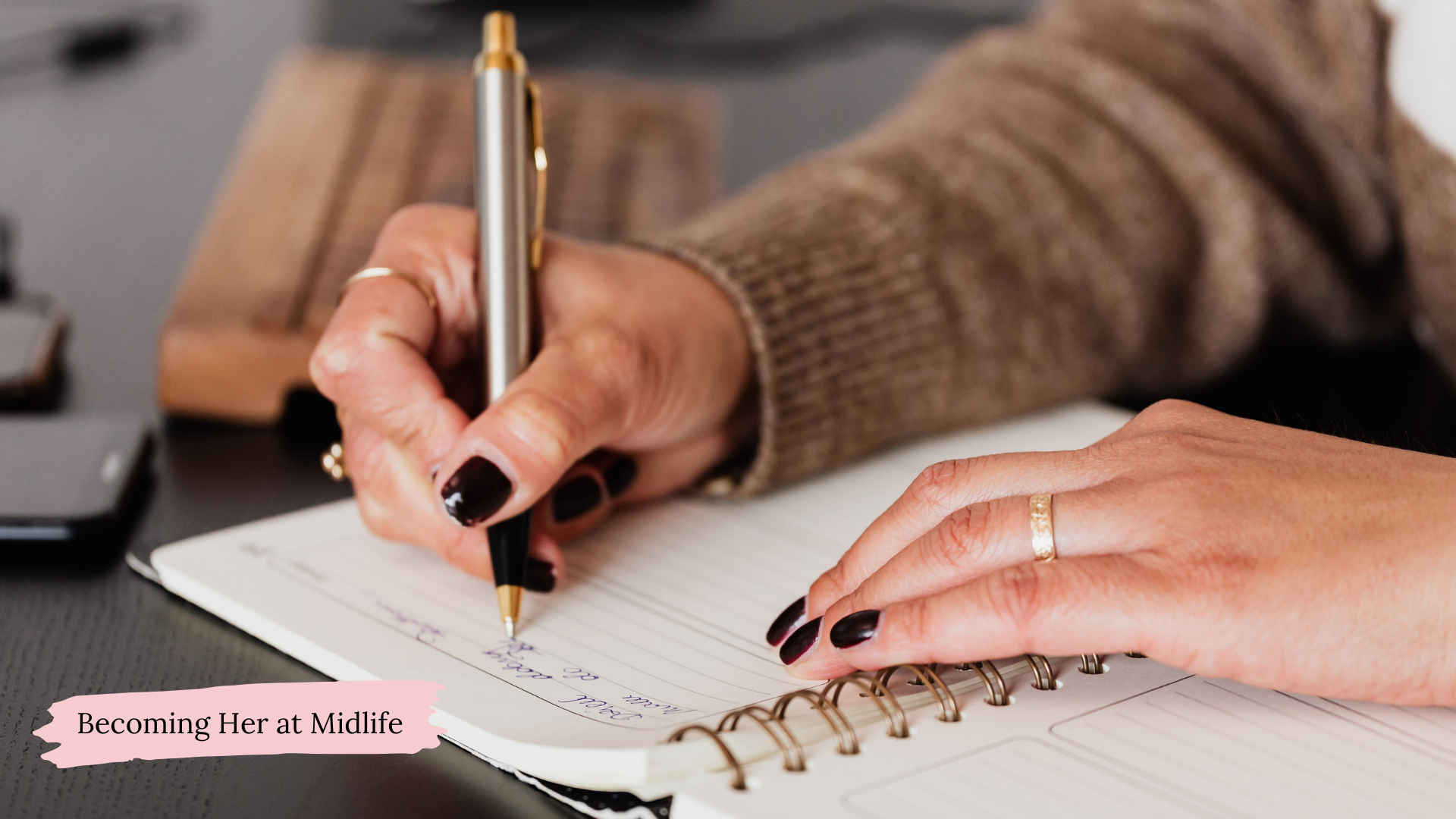
Identity journaling is the practice of using guided prompts and reflection questions to help you get honest about who you are right now, not who you used to be or who others expect you to be, but who you actually are at this point in your life.
It works because it slows you down. Midlife can feel relentless, like you’re constantly reacting to life rather than choosing it.
When you sit down with a journal and a thoughtful prompt, you create space for the kind of reflection that everyday life rarely allows.
Over time, those quiet pages begin to reveal patterns, desires, fears, and strengths that you may have buried under years of responsibility and people-pleasing.
For women navigating midlife identity shifts, this kind of inner work isn’t a luxury; it’s a lifeline.
The Difference Between Journaling and Guided Journaling
A lot of women tell me they’ve tried journaling before and just stared at a blank page without knowing what to write. That’s the difference between freewriting and guided journaling, and it matters more than most people realize.
Freewriting can be powerful once you’re practiced at it, but when you’re in the middle of a midlife identity crisis, a blank page can feel like one more thing asking something of you.
Whereas a guided journal gives you a prompt, a question, or a gentle direction to follow. It removes the pressure of figuring out where to start, which is often the hardest part of any inner work.
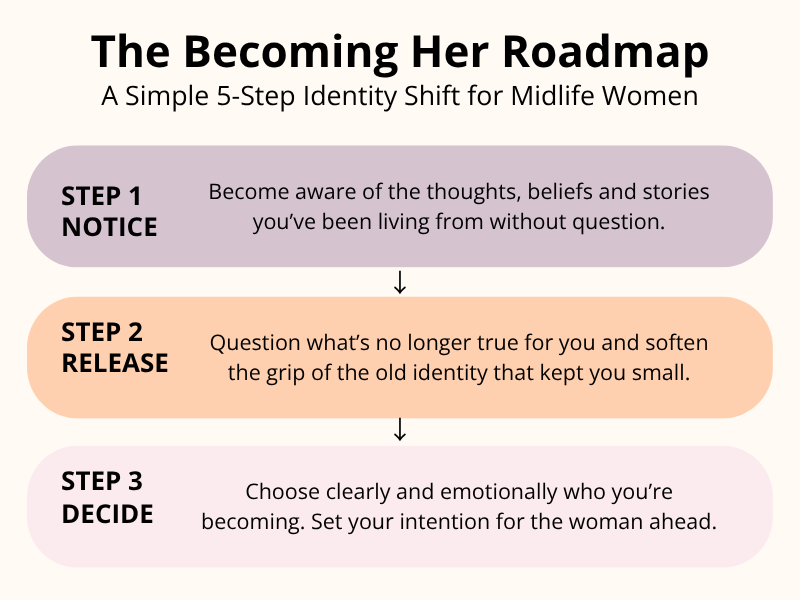
🌸 Not Sure Where To Start?
The Becoming Her Roadmap is a free 5-step framework for midlife identity shift.
Show Me The RoadmapThink of it less like homework and more like a conversation you’ve been wanting to have with yourself for years. The journal asks the question, and you simply answer honestly.
Why Midlife Is the Right Time to Start This Practice
Women in their 40s, 50s, and early 60s are often at a pivotal turning point. The roles that once defined them, mother, wife, caregiver, career woman, may be shifting or falling away entirely.
The empty nest arrives. A marriage ends. Retirement approaches. And suddenly the question “who am I now?” isn’t abstract anymore – it’s urgent.
I’ve seen this pattern over and over again – and I’ve been through this myself – and I truly believe that this particular moment of disruption is actually an invitation. Not a comfortable one, but a genuine opening.
When the old structures fall away, there is finally space to ask bigger questions about what you want, what you value, and who you are underneath all the roles you’ve played.
Journaling in midlife gives you a structured way to walk through that opening rather than standing frozen in the doorway.
What 30 Days of Identity Journaling Can Do for You
The transformation that happens over 30 days of consistent journaling isn’t dramatic or sudden; it’s quiet and cumulative.
You begin to notice things, small shifts in how you speak about yourself, moments when you catch an old belief and question it for the first time, glimpses of the woman you want to become.
Here are some of the things women commonly experience after 30 days of guided identity journaling:
Greater clarity about their values. When you spend time reflecting on what actually matters to you rather than what you think should matter, your priorities begin to come into sharper focus.
A softer relationship with the past. Journaling creates distance and perspective. Many women find that they’re able to release long-held guilt or regret simply by writing it out and examining it honestly.
A growing sense of excitement about the future. This one surprises people the most. Women who started journaling feeling stuck and lost often describe a quiet but growing sense of possibility by the end of 30 days.
More confidence in their own voice. When you practice articulating your inner world on paper, you become more comfortable owning that inner world in your outer life too.
These are not small things; these are the beginnings of a genuine identity shift.
Becoming Her: A Journal Built for This Season
This is where I want to tell you about something I created specifically for women in this exact season of life.
It’s my Becoming Her: A 30-Day Identity Shift Journal for Midlife Women, which is a guided journal designed to walk you through a month of intentional self-discovery, one thoughtful prompt at a time.
It isn’t about productivity or goal-setting, and it isn’t about fixing yourself or optimizing your life. It’s about returning to yourself, gently and at your own pace, and beginning to understand who you are becoming in this next chapter.
Each day builds on the last, taking you deeper into questions about identity, values, self-worth, and the future you’re quietly calling in.
Women who have worked through it describe it as the kind of inner conversation they’ve needed for years but never knew how to start.
Go here to learn more about how my Becoming Her Journal can walk you through this season of reinvention, one page at a time.
How to Make Journaling Feel Sustainable in Midlife
One of the biggest obstacles to starting a journaling practice isn’t motivation; it’s the belief that you need a big block of time to do it properly.
You don’t.
The most sustainable journaling practices are built on small, consistent moments rather than long sessions.
Here are a few ways to make it work in a real midlife life:
Start with ten minutes. Set a timer, sit with your prompt, and write until the timer goes off. Ten minutes of honest reflection is worth more than an hour of overthinking.
Choose one anchor moment. First thing in the morning, before the day gets loud, or last thing at night when the house is quiet. Attaching your journaling practice to an existing habit makes it easier to maintain.
Let yourself be imperfect. Some days your writing will feel deep and meaningful. Other days it will feel flat and forced. Both are valuable – show up anyway.
Don’t edit yourself. Your journal is not a performance. Write what’s true, not what sounds good. The messy, unpolished thoughts are often the most revealing ones.
Treat it as a gift to yourself. In midlife, women are often still last on their own list. A daily journaling practice is one quiet, consistent way of telling yourself that you matter.
You Don’t Have to Have It All Figured Out to Begin
One of the most common things I hear from women who are hesitant to start journaling is that they’re waiting until they feel ready, or until things settle down, or until they know what they’re looking for.
But that’s the thing about identity work: you don’t have to know where you’re going in order to start; you just have to be willing to show up on the page and be honest.
The woman you’re becoming doesn’t need you to have all the answers; she just needs you to start asking the questions.
If you’re ready to begin that conversation with yourself, Becoming Her: A 30-Day Identity Shift Journal for Midlife Women is waiting for you. It was created for exactly this moment, and it will meet you exactly where you are.
Your next chapter doesn’t start when everything is perfect.
It starts when you decide to begin.
🌸 Ready to go deeper?
The Becoming Her Journal was made for exactly this moment. Thirty days of guided prompts, reflections, and identity work written just for you.
Show Me The Journal