The Difference Between a Goal and an Intention (And Why It Matters at 50)

You’ve probably set hundreds of goals in your lifetime, and somewhere along the way, you either fell short on some of them or found yourself wondering why reaching them never quite felt like enough.
That quiet “now what?” feeling after a big win is more common than most women talk about.
If that sounds familiar, understanding the real difference between setting intentions vs goals might be the shift you’ve been looking for.
If something brought you here today, it might be worth exploring further with Becoming Her: A 30-Day Identity Shift Journal for Midlife Women. This is a 30-day guided journal designed specifically for women navigating the beautiful, complicated work of midlife reinvention.
This isn’t a small, subtle thing. It’s a completely different way of approaching change, and at 50, it’s the approach that actually works.
Why Goals Start to Feel Empty in Midlife
For decades, you were taught to set goals, and maybe you hit plenty of them.
But here’s what nobody told you about the goal-setting model:
- It keeps your attention fixed on a finish line that’s always just a little further ahead.
- It ties your sense of worth to outcomes you may or may not be able to control.
- It measures success by what you’ve achieved, never by who you’re becoming.
- And when you finally cross the finish line, there’s often a brief moment of satisfaction followed quickly by the thought: “Is this it?”
I’ve seen this pattern over and over in women who are brilliant, capable, and quietly exhausted by their own high standards.
The problem isn’t you, it’s the tool.
Goals ask: What do I want to have?
And there’s nothing wrong with that question, but at this stage of your life, it’s probably not the most important one.
What an Intention Actually Is
An intention asks something deeper.
Intentions ask: Who do I want to become?
Goals ask: What do I want to have?
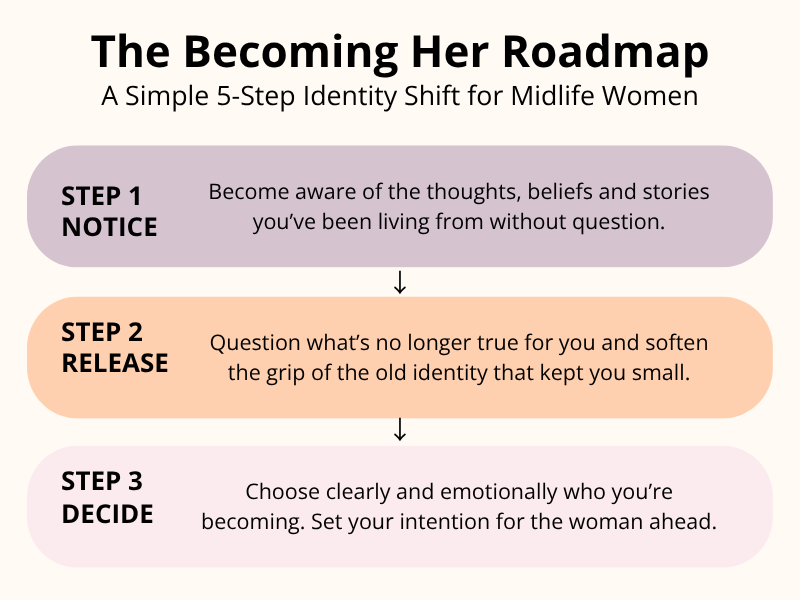
🌸 Not Sure Where To Start?
The Becoming Her Roadmap is a free 5-step framework for midlife identity shift.
Show Me The RoadmapIntentions ask: Who do I want to become?
That’s a completely different starting point.
Here’s how the two approaches compare side by side:
- A goal focuses on the destination. An intention focuses on who you are as you travel toward it.
- A goal is measured by outcomes. An intention is measured by alignment.
- A goal lives in the future. An intention lives in how you show up today.
When you set an intention, you’re not just planning for an outcome; you’re choosing a new energy, a new identity, a new way of showing up for yourself each day.
Intentions are quieter than goals; they don’t have deadlines, metrics, or boxes to check. But they work on something that goals never quite reach: your subconscious sense of who you actually are.
Intentions reprogram your inner world by giving your mind a new emotional frequency to align with.
So instead of pushing against old belief patterns, you begin creating new ones through repetition, awareness, and the slow but real work of becoming someone different.
Why This Matters More at 50 Than at Any Other Time
Here’s the thing about midlife: you’ve lived enough life to know what doesn’t feel good anymore.
You can sense when something is out of alignment, when you’re performing a version of yourself that doesn’t quite fit, and when what you truly crave is peace and meaning rather than more striving and proving.
You’re not starting over; you’re realigning. And that requires a different tool than the goal-setting approach you used in your 30s.
The women who feel most stuck at this stage aren’t stuck because they’ve stopped caring; they’re stuck because they’re still using goal-oriented thinking to solve an identity-level problem.
They keep asking “what should I do?” when the real question is “who am I becoming?“
How to Know the Difference in Practice
The shift is subtle but incredibly powerful once you feel it.
Here’s what it looks like in real life:
- A goal says: “I want to feel more confident.” An intention says: “I am becoming the woman who trusts herself fully.”
- A goal says: “I want to stop putting everyone else first.” An intention says: “I am the woman who honors her own needs without apology.”
- A goal says: “I want to find my purpose.” An intention says: “I am becoming the woman who lives with direction and meaning every single day.”
Do you see, and more importantly, feel the difference?
Goals describe what you’re chasing, whereas intentions describe who you already are in the process of becoming.
And that matters because your subconscious mind responds to identity, not to to-do lists.
What Makes a Good Intention
A strong intention doesn’t have to be elaborate or poetic.
The best ones are simple, sincere, and emotionally true. You’ll know it’s right when it feels expansive rather than pressured, when it stretches you slightly without feeling like a task to complete.
Here’s what to keep in mind when you’re choosing yours:
- It focuses on who you’re being, not what you’re achieving. Start with “I am” or “I am becoming.”
- It feels emotionally connected. If it doesn’t move something in you, it won’t move much in your life either.
- It’s believable enough to feel possible. The most effective intentions sit just outside your comfort zone, not so far that your inner critic dismisses them immediately.
- It’s rooted in how you want to feel, not just what you want to have. Peace, confidence, ease, freedom, alignment. These are identity words, and they’re far more powerful than outcome words.
Related Reading: How To Find New Passions & Interests After 50
The Shift That Changes Everything
When you stop chasing goals and start setting intentions, something changes in how you relate to your own life. You stop white-knuckling your way toward a future version of yourself and start showing up as her now, in small and quiet ways, every single day.
This is the approach behind the Becoming Her Journal, and it’s why the 30-day journey starts not with a goal but with an intention.
You’re not trying to achieve something in 30 days; you’re practicing becoming someone, which is a different kind of work entirely, and a far more lasting one.
🌸 Ready to go deeper?
The Becoming Her Journal was made for exactly this moment. Thirty days of guided prompts, reflections, and identity work written just for you.
Show Me The Journal