Midlife Transition vs Midlife Crisis: What’s Really Happening to You

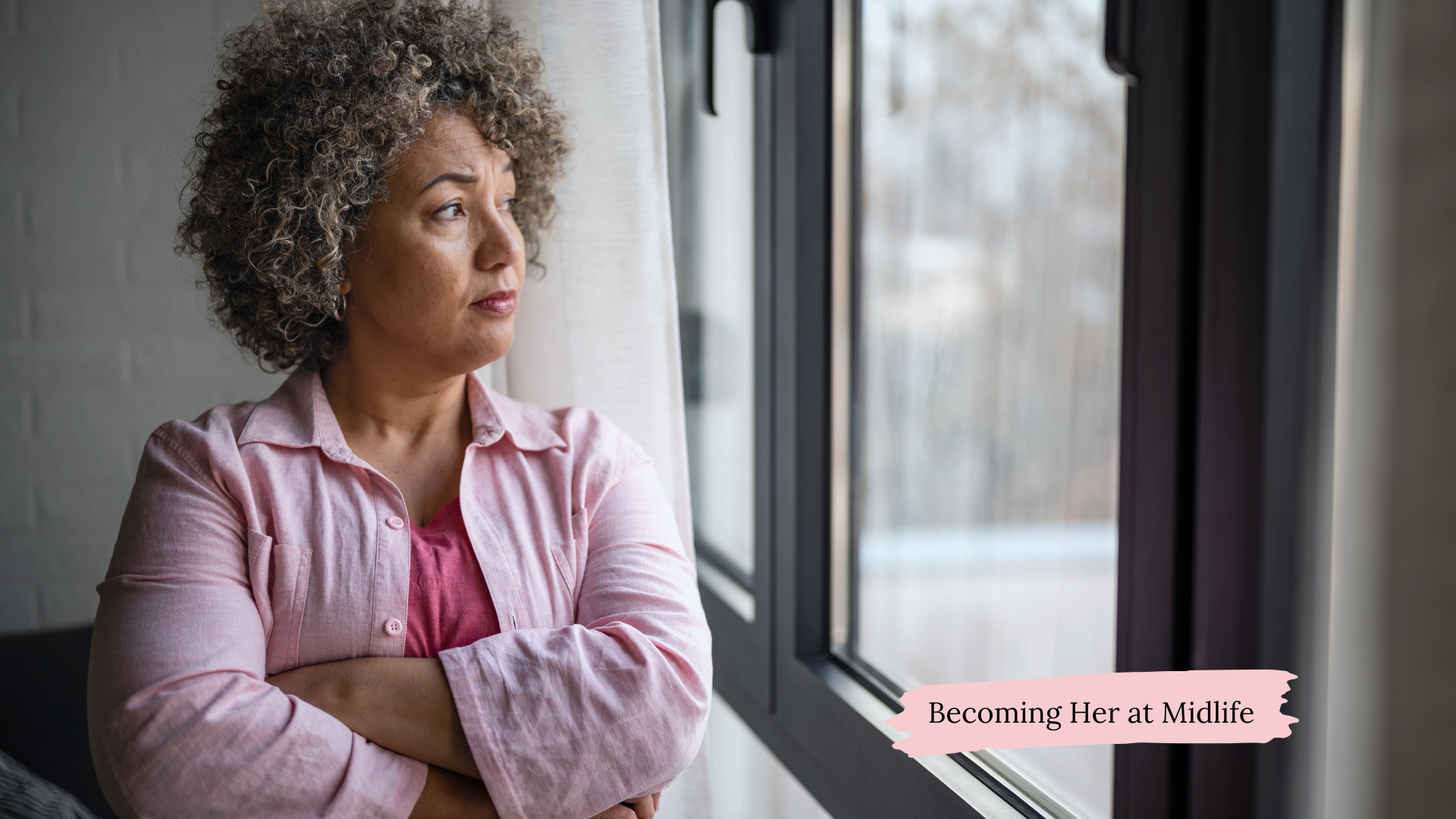
If you’ve been feeling unsettled, restless, or quietly desperate for something to change, you might be wondering whether you’re going through a midlife transition or a full-blown midlife crisis – and whether there’s even a difference worth knowing about.
Let me tell you that there is a difference, and understanding that difference could completely change how you feel about what you’re experiencing right now.
Something brought you to this page today, and I don’t think that’s an accident – if you’re feeling the pull toward something more, my Becoming Her: A 30-Day Identity Shift Journal for Midlife Women is a gentle, guided way to start exploring who you really are in this next chapter of your life.
The short answer is this:
➤ A midlife crisis is something that happens to you, framed as a breakdown or an emergency.
➤ A midlife transition is something that moves through you, and when you understand it for what it is, it becomes one of the most powerful invitations of your life.
What We’ve Been Told About the “Midlife Crisis”
The phrase “midlife crisis” has been around since the 1960s, and it comes loaded with cultural baggage that’s mostly unhelpful for women navigating this stage. It conjures images of dramatic decisions, impulsive reinventions, and the sense that something has gone terribly wrong.
For women, especially, it often gets dismissed or minimized. You’re told you’re being too emotional, that it’ll pass, or that you should feel grateful for everything you already have.
But here’s what I truly believe: what you’re feeling isn’t dysfunction; it’s information, and it deserves to be taken seriously.
What a Midlife Transition Actually Is
A midlife transition is a psychological and emotional shift that tends to happen somewhere between your mid-40s and your late 50s, and it’s far more common, more nuanced, and more purposeful than any “crisis” framing allows.
Here’s what it often looks like in real life:
- A growing sense that the life you’ve been living no longer fits who you are
- Feeling invisible, overlooked, or genuinely unsure of your own identity
- Restlessness that doesn’t go away, even when nothing is technically “wrong”
- A quiet but persistent voice asking, Is this really it?
- Grief for the person you thought you’d become by now
- A deep longing for something you can’t quite name yet
I’ve described this feeling to myself as standing at a crossroads without a map, and I know I’m not the only one.
That’s not a crisis, that’s a call to go inward.
The Key Difference Between Crisis and Transition
A crisis implies emergency, panic, and the need to fix something fast. It puts you in a reactive mode where you’re trying to escape the discomfort rather than understand it.
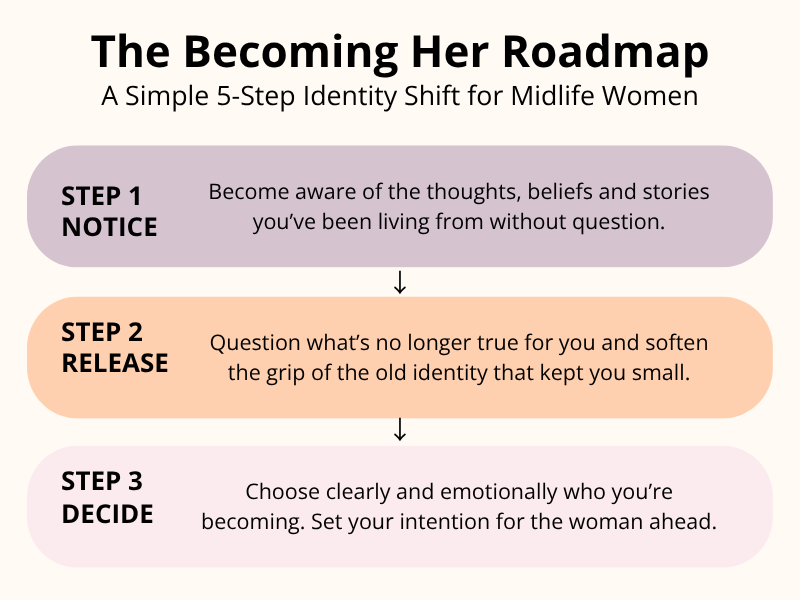
🌸 Not Sure Where To Start?
The Becoming Her Roadmap is a free 5-step framework for midlife identity shift.
Show Me The RoadmapWhereas a transition, by contrast, is a passage – a natural, expected movement from one version of yourself to another, and a sign that you’re paying attention to your own life.
The difference often comes down to how you relate to what you’re feeling:
- Crisis thinking says: something is wrong with me, and I need to escape this fast.
- Transition thinking says: something in me is outgrowing the life I’ve built, and it’s asking me to grow with it.
That shift in perspective changes everything about what you do next.
Why This Happens in Midlife Specifically
There’s something almost inevitable about the way midlife brings this reckoning.
By the time you’re in your 40s or 50s, you’ve spent decades building an identity around your roles, your relationships, your responsibilities, and the expectations that other people had of you.
And then, often quietly at first, those roles start to change. Children grow up, careers plateau or end, marriages shift, and parents age. The external structure that once told you who you were starts to feel unstable, and what’s left is the question you maybe never had time to ask before: Who am I, apart from everything I do for everyone else?
That question isn’t a crisis; it’s one of the most important questions you’ll ever sit with.
Signs You’re in a Transition, Not a Breakdown
If you’re not sure which one you’re in, here are a few signs that what you’re experiencing is a transition worth leaning into:
- You feel the restlessness most acutely in quiet moments, not chaotic ones
- There’s a sense of anticipation underneath the uncertainty, even if it’s hard to access
- You find yourself drawn to ideas, people, or experiences that feel like a more authentic version of you
- The life you have looks fine from the outside, but something inside you keeps asking for more
- You’re craving depth, meaning, and connection rather than distraction
These aren’t symptoms of something going wrong; they’re signals that something important is ready to change.
What to Do When You’re in the Middle of It
The most powerful thing you can do in a midlife transition isn’t to force a decision or overhaul your life overnight; it’s to turn toward yourself with curiosity rather than fear.
That means:
- Getting quiet enough to hear what you actually want, underneath all the noise of obligation
- Starting to question the beliefs and stories you’ve been carrying about who you are and what’s possible for you
- Giving yourself permission to want something different, even if you can’t see the full picture yet
- Exploring your identity slowly and deliberately, rather than reacting from a place of panic
This is the shift that changed everything for me, and I genuinely believe it can do the same for you.
The Invitation Inside Every Midlife Transition
Every midlife transition carries a specific invitation.
It’s asking you to release the version of yourself that was built for everyone else and to start discovering who you actually are now, at this stage, with everything you’ve lived and learned and survived.
That’s not a crisis, that’s becoming.
When you start to see your midlife transition vs midlife crisis through that lens, the restlessness doesn’t disappear overnight, but it starts to make sense. It starts to feel less like something to escape and more like something to walk through with intention.
If you’re ready to do that inner work with some real structure and support, the Becoming Her 30-Day Identity Shift Journal was created exactly for this moment.
It’s a gentle, guided journey through the questions that matter most, written by someone who needed it just as much as you do. I still use it today, and I hope it resonates with you too.
🌸 Ready to go deeper?
The Becoming Her Journal was made for exactly this moment. Thirty days of guided prompts, reflections, and identity work written just for you.
Show Me The Journal