Do Affirmations Actually Work? Here’s What the Research Says


If you’ve ever stood in front of your bathroom mirror repeating “I am confident, I am worthy, I am enough” and wondered whether you’re doing anything more than talking to yourself, you’re not alone.
So many of us have tried affirmations, felt a little silly, and quietly given up on them.
Here’s the short answer to whether affirmations actually work: yes, but not in the way most people expect.
Research on self-affirmation shows real, measurable benefits for wellbeing and resilience, but only when the affirmations are used a specific way. If they’re said out loud without belief or context, then they tend to fizzle out fast.
Let’s get into what the research actually shows, and why the version of affirmations most of us were taught is missing a crucial piece.
Something brought you to this page today, and I don’t think that’s an accident – if you’re feeling the pull toward something more, my Becoming Her: A 30-Day Identity Shift Journal for Midlife Women is a gentle, guided way to start exploring who you really are in this next chapter of your life.
What the Research Actually Says About Affirmations
Affirmations aren’t just a wellness trend; they’re rooted in something called self-affirmation theory, first developed by psychologist Claude Steele in the late 1980s.
The theory looks at how people protect their sense of self-worth when they’re facing something threatening, like failure, criticism, or a moment that shakes their self-image, and it remains a well-studied area of social psychology today. EBSCOWikipedia
A 2025 review that combined findings from 67 studies looked specifically at how writing or repeating positive affirmations affects wellbeing. A separate, larger analysis reviewed data from an even bigger pool of research. The Conversation
Here’s what the evidence actually points to:
- Self-affirmation exercises have been shown to improve academic performance in students who felt underrepresented, and to increase motivation to quit smoking. APA
- These exercises seem to work by reminding people of their own inner strengths, which then act like a buffer against outside stress and worry. APA
- Self-affirmation doesn’t work the same for everyone. A number of personal and situational factors shape whether it helps, so the benefits tend to show up under certain conditions rather than universally. ScienceDirect
- The people who seem to benefit most are often the ones who are already feeling vulnerable or worried about being judged. ScienceDirect
So the research is real. It’s just more nuanced than “say nice things to yourself and your life changes.”
Why Affirmations Alone Often Fall Flat
Here’s what I think gets lost when affirmations get turned into a quick fix. Most of us were taught to repeat a sentence we don’t actually believe yet, hoping the words alone would do the work.
I’ve tried that version myself, and it never stuck. It just felt like I was lying to myself in the mirror every morning.
The research backs this up too. Affirmations tend to work best when they connect to something that genuinely matters to the person saying them, not a generic phrase borrowed from a list online.
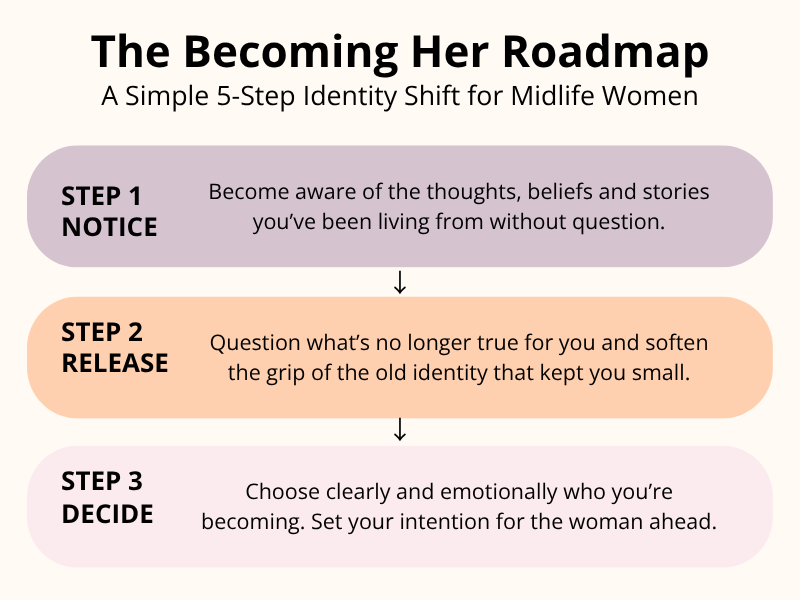
🌸 Not Sure Where To Start?
The Becoming Her Roadmap is a free 5-step framework for midlife identity shift.
Show Me The RoadmapWhen the words feel disconnected from anything real, your brain just doesn’t buy it. ScienceDirectiResearchNet
This is actually the exact gap I built the Becoming Her Blueprint to close. It’s the five-step identity shift framework I created for this blog and the journal, and it treats affirmations as one small piece of a bigger process rather than the whole solution.
If you haven’t come across it yet, you can read the full breakdown of the Becoming Her Blueprint here.
The five steps are
- Notice
- Release
- Decide
- Repeat, and
- Trust.
Affirmations live inside the Repeat step, but they only carry weight once you’ve already done the earlier work of noticing your old story and deciding on the new one.
How to Use Affirmations the Way That Actually Works
Once you understand why affirmations sometimes fail, it’s a lot easier to use them in a way that actually resonates.
The goal isn’t to trick yourself into believing something overnight; it’s to gently repeat a new identity until your brain starts to accept it as true.
Here’s what tends to make the biggest difference:
- Write your affirmation in the present tense, starting with “I am,” not “I will be” or “I hope to be.”
- Choose a statement that reflects the woman you’re deciding to become, not a random phrase that sounds nice.
- Say it out loud during small daily moments, like folding laundry, walking, or getting ready in the morning, so it becomes woven into your day instead of a once-a-day chore.
- Pair the words with a feeling. Notice how it feels in your body to say “I am calm and confident” rather than just reciting it.
- Repeat it especially in the moments your old thoughts try to creep back in. That’s when it matters most.
I’m still working through this myself, honestly. Some days the affirmation feels completely natural, and other days I catch myself doubting it halfway through the sentence. What I’ve learned is that the doubt isn’t a sign it’s not working; it’s just your old identity putting up a little resistance before the new one takes hold.
Where Affirmations Fit Into the Bigger Picture
Affirmations were never meant to be a standalone fix, and that’s probably why so many of us felt let down by them in the past. They’re one tool inside a much bigger identity shift, and they work best alongside the other steps in the process, like releasing the beliefs that no longer serve you and deciding clearly who you’re becoming next.
That’s the whole idea behind the system I put together after doing this work on myself. Affirmations paired with intention, repetition, and a little trust in the process tend to create real, lasting change, not because the words are magic, but because repetition genuinely does reshape the beliefs running quietly in the background of your day.
If you’ve been repeating affirmations and wondering why nothing seems to shift, it might not be the affirmations themselves. It might just be that they’re missing the foundation underneath them.
That foundation is exactly what the Becoming Her Journal walks you through, one day at a time. It’s a 30-day guided process that helps you notice your old story, release what’s no longer true, and build daily affirmations and small actions around the woman you’re actually becoming. If today’s post resonated with you, it might be worth taking a look.
🌸 Ready to go deeper?
The Becoming Her Journal was made for exactly this moment. Thirty days of guided prompts, reflections, and identity work written just for you.
Show Me The Journal