
How Daily Journaling Literally Rewires Your Brain (The Science Made Simple)


You’ve probably picked up a journal at some point in your life and put it down again a few days later, wondering why something that sounded so good in theory felt so hard to stick with in practice.
I did the exact same thing for years. I’d buy a beautiful notebook, write three entries, and quietly give up, convinced journaling just wasn’t for me.
What changed everything wasn’t willpower. It was understanding what’s actually happening in your brain when you sit down and write, because once you see it, a daily journaling practice stops feeling like a nice-to-have and starts feeling like a tool you’re using on purpose.
If something brought you here today, it might be worth exploring further with Becoming Her: A 30-Day Identity Shift Journal for Midlife Women. This is a 30-day guided journal designed specifically for women navigating the beautiful, complicated work of midlife reinvention.
Your Brain Is Already Rewiring Itself, Whether You Notice Or Not
Here’s something most of us never stop to think about. You have roughly 60,000 thoughts a day, and the majority of them are the same ones you had yesterday.
If your mind has been looping around stories like “I’ve lost myself” or “it’s too late to start over,” your brain isn’t punishing you. It’s just doing what it’s designed to do, which is follow the instructions you’ve been giving it for years, whether or not they’re actually true.
This happens through a part of your brain called the reticular activating system, or RAS. Your RAS filters the flood of information coming at you every second and decides what’s worth noticing based on what you’ve already told it matters.
It’s the same reason you buy a certain car and suddenly start seeing that exact model everywhere. The cars aren’t new; it’s just your RAS just started letting them through.
What Actually Happens When You Write Something Down
A thought that stays in your head is easy to lose. It loops for a while, fades, and gets talked over by the next thought that comes along.
A thought you write down is different. It has to become specific, and it has to sit still on the page long enough for you to actually look at it.
Here’s what that does for you:
- It slows a racing thought down enough to examine instead of just react to it
- It turns a vague feeling into something specific you can actually work with
- It creates a record your brain starts to treat as more true, simply because you keep encountering it
- It builds a kind of consistency a passing thought never gives you
That last point matters more than it sounds like it should. A thought can slip by unnoticed, but a page you sit down and write every day can’t. I’m still working on this myself, but I’ve noticed that the days I skip are the days old stories creep back in the fastest.
Signs Your Journaling Practice Is Actually Changing How You Think
This shift tends to happen quietly at first.
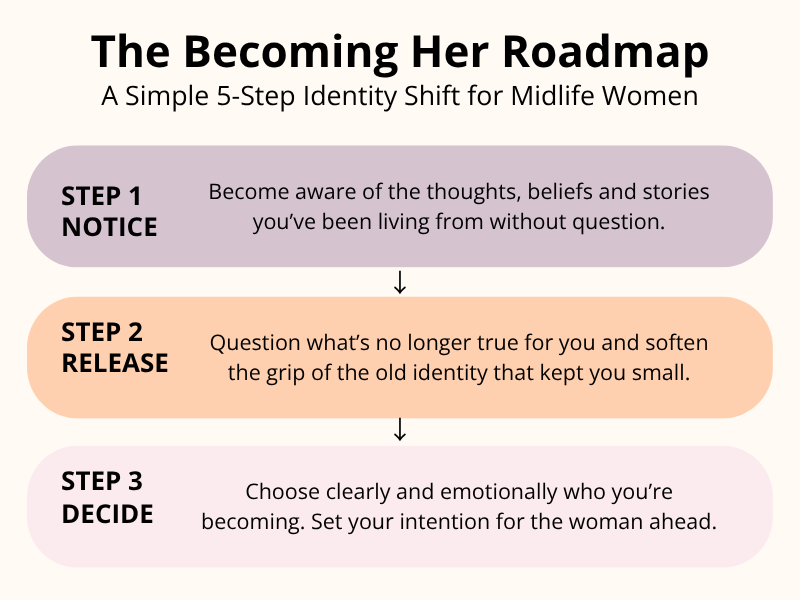
🌸 Not Sure Where To Start?
The Becoming Her Roadmap is a free 5-step framework for midlife identity shift.
Show Me The RoadmapHere are a few subtle signs it’s working, even when it doesn’t feel dramatic:
- You catch a negative thought mid-sentence instead of hours later
- You notice yourself reaching for evidence that supports a new belief, not just the old one
- Certain worries that used to consume your whole day start losing their grip a little faster
- You feel a flicker of curiosity about who you’re becoming instead of dread about who you used to be
- Writing starts to feel like relief instead of a chore
If even one of these sounds familiar, that’s your brain doing exactly what it’s designed to do when you give it consistent, written repetition to work with.
Why Repetition Is the Real Engine Behind Change
New beliefs don’t take root because you had one powerful insight in the shower. They take root through repetition and emotion, the same way your old beliefs did.
The more often you think and feel something, the more your brain starts to weigh it as true. That’s not a metaphor; it’s the same mechanism that built the stories you’re trying to move past now, just pointed in a new direction on purpose.
This is why writing your intention daily matters so much more than writing it once and hoping it sticks. You’re not just repeating a sentence; you’re gradually rebuilding the belief system underneath it, one repetition at a time.
I created the Becoming Her Roadmap as a simple 5-step identity shift framework for midlife women, and journaling threads through nearly every part of it. It’s how you Notice the old thoughts running the show, and it’s how you Repeat the new ones until they actually feel true.
If you haven’t seen the full framework yet, the Becoming Her Roadmap walks through all five steps in order.
Simple Ways to Start a Daily Journaling Practice That Actually Sticks
You don’t need an hour or a perfect system; you just need something small enough that you’ll actually do it on the days you don’t feel like it.
- Start with five minutes, not fifty. Consistency beats duration every time.
- Write one sentence that starts with “I am becoming the woman who…” even on days you don’t fully believe it yet.
- Keep your journal somewhere you’ll actually see it, not tucked away in a drawer.
- Pair it with something you already do daily, like your morning coffee, so it attaches to an existing habit.
- Give yourself permission to write messy. Nobody is grading this.
The goal was never perfect entries. It was consistent ones, because consistency is what your brain actually responds to.
The Real Shift Happens Quietly, Page by Page
I won’t pretend journaling fixed everything overnight, because it didn’t, and I’m honestly still figuring parts of this out myself. But what I know for sure is that the version of me writing this today thinks differently than the version who gave up after three entries.
That’s what a daily journaling practice actually does. It doesn’t demand a dramatic before and after; it just quietly, repeatedly, gives your brain new evidence to work with until the new story starts to feel like the true one.
If you’re ready to make that practice structured instead of scattered, the Becoming Her Journal walks you through 30 days of guided prompts built around this exact process, so you’re never staring at a blank page wondering where to start.
🌸 Ready to go deeper?
The Becoming Her Journal was made for exactly this moment. Thirty days of guided prompts, reflections, and identity work written just for you.
Show Me The Journal