5 Powerful Limiting Beliefs Journal Prompts to Help You Rediscover Who You Really Are


If you’ve been feeling stuck in midlife and can’t quite explain why, limiting beliefs journal prompts might be exactly what you need to start finding your way through.
A limiting belief is simply a story you’ve been telling yourself for so long that it has started to feel like a fact, and journaling is one of the most effective ways to surface those stories, examine them honestly, and begin to release them.
In this post, you’ll find five powerful prompts to get you started, along with guidance on how to build a simple journaling practice that creates real change over time.
If something brought you here today, it might be worth exploring further with Becoming Her: A 30-Day Identity Shift Journal for Midlife Women. This is a 30-day guided journal designed specifically for women navigating the beautiful, complicated work of midlife reinvention.
What Is a Limiting Beliefs Journal?
A limiting beliefs journal is a dedicated space where you identify, examine, and begin to release the beliefs that have been quietly running your life.
It doesn’t need to follow a strict format or take up an hour of your morning, but what it needs to be is honest.
The process is straightforward.
You write down the belief exactly as it sounds in your head, without softening it or talking yourself out of it.
You then sit with it.
You ask where it came from and whether it’s actually true.
And then, slowly and gently, you begin to loosen its grip.
When a limiting belief lives only in your head, it feels like the truth. It narrates your days, shapes your decisions, and keeps you circling the same familiar ground.
But when you write it down and look at it, something shifts. It becomes a sentence on a page rather than a fact about your life, and that distance is where real change begins.
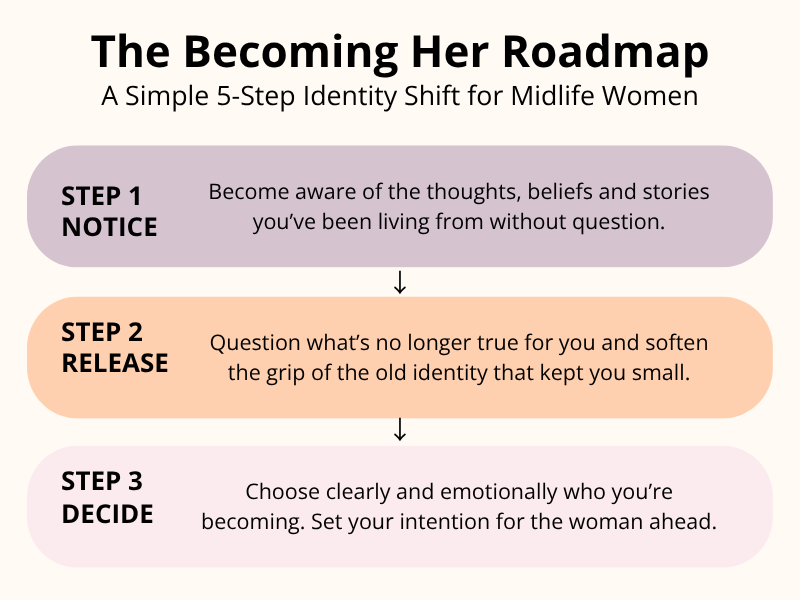
🌸 Not Sure Where To Start?
The Becoming Her Roadmap is a free 5-step framework for midlife identity shift.
Show Me The RoadmapLimiting Beliefs Journal Prompts to Start With
These five limiting beliefs journal prompts are designed to help you surface what has been hiding beneath the surface and begin moving through it.
Take them one at a time and give each one the space it deserves.
Prompt #1: What is one thing I keep telling myself I can’t do, and where did that story begin?
This is the foundational question. Most limiting beliefs have a clear origin point, a parent’s voice, a painful experience, a relationship that quietly redefined what you thought you were worth.
Writing toward that origin doesn’t mean dwelling in the past; it means understanding why the belief feels so real so you can start to question it with compassion rather than frustration.
Prompt #2: If I knew this belief was completely false, what would I do differently tomorrow?
This prompt bypasses the part of your brain that wants to argue and defend. It invites you into possibility instead.
The answers that come up here are often surprising, and they tend to point directly toward what you actually want most deeply.
Prompt #3: Who taught me to think this way, and is that person’s opinion still relevant to my life today?
So many of the beliefs keeping women stuck in midlife were handed down by someone else, a parent, a culture, a marriage, a version of yourself that no longer exists.
This prompt helps you see the belief as borrowed rather than built-in, and borrowed things can be returned.
Prompt #4: What would the most courageous version of me believe about herself instead?
This is where the rewriting begins. You’re not forcing toxic positivity or pretending the old belief never existed; you’re simply trying on a new story and seeing how it feels to wear it.
Even sitting with the possibility that a different belief could be true is enough to start shifting something.
Prompt #5: What has this belief been protecting me from, and do I still need that protection?
This one is worth sitting with slowly.
Limiting beliefs are often defense mechanisms that made perfect sense at some point in your life. So by recognizing what they were protecting you from, you can release them with gratitude rather than anger, which makes the release so much more lasting.
Common Limiting Beliefs Examples That Come Up in Journaling
If you’re not sure where to start, these are some of the most common limiting beliefs examples that surface for women in midlife.
See if any of them feel familiar:
“It’s too late for me to change.”
“I don’t deserve to want more than this.”
“I’ve never been the kind of person who follows through.”
“If I change, the people I love won’t recognize me anymore.”
“My best years are already behind me.”
None of these are true.
But all of them feel true when they’ve lived in your head long enough.
That’s exactly why writing them down, examining them honestly, and gently challenging them is some of the most important work you can do in midlife.
How to Build a Limiting Beliefs Journaling Practice That Sticks
You don’t need a perfectly quiet morning or an hour of uninterrupted time. What you need is consistency over perfection.
Even ten minutes with one prompt, three or four times a week, will create genuine movement over time.
Start by choosing one belief that feels most present for you right now and work through the prompts in relation to that single belief before moving on to another.
Going deep with one belief will teach you far more than skimming the surface of many.
Keep your journal somewhere visible so it doesn’t become another thing you intend to do, and try to write without editing yourself as you go.
The messy, unfiltered version of your thoughts is where the real work lives.
I remember the first time I let myself write something down without immediately softening it, and the clarity that followed was unlike anything I had found by thinking alone.
Why Midlife Is the Perfect Time for This Work
There’s a reason limiting beliefs journaling resonates so deeply with women in their 50s.
By this stage of life, many of those beliefs have been running quietly in the background for decades, shaping choices, dimming ambitions, and keeping you safely inside a life that may no longer fit who you are becoming.
Midlife also tends to bring the kind of disruptions, empty nest, divorce, retirement, a growing sense of inner restlessness, that crack those old stories open just enough for light to get in.
That discomfort you may be feeling right now is not a sign that something is wrong with you. It’s an invitation to look more closely at what you’ve been believing and ask whether it still deserves a place in your next chapter.
Your Next Step
If you’re ready to go beyond individual prompts and want a fully guided experience built specifically for this season of your life, the Becoming Her journal was created for exactly this moment.
Over 30 days it walks you through the process of uncovering the beliefs, stories, and identities that no longer serve you and stepping into who you are truly becoming.
This is your next step, and it’s a good one.
🌸 Ready to go deeper?
The Becoming Her Journal was made for exactly this moment. Thirty days of guided prompts, reflections, and identity work written just for you.
Show Me The Journal